Thursday, February 18, 2021


Thursday, February 4, 2021
Saturday, June 6, 2020
Friday, April 3, 2020
Thursday, May 31, 2018
Friday, May 4, 2018
Thursday, April 5, 2018
6 Portrait Drawing Mistakes You Will Never Make Again
----
6 Portrait Drawing Mistakes You Will Never Make Again
// The Drawing Blog
Plus Drawing Eyes, Noses, Mouths and Skin The wise artist approaches the landscape of the face with a good bit of respect. There is so much nuance and subtlety in such a small amount of real estate that you can easily get into "danger" territory and not quite know how you got there. Here are […]
The post 6 Portrait Drawing Mistakes You Will Never Make Again appeared first on Artists Network.
----
Read in my feedly
Wednesday, January 17, 2018
Eye Candy for Today: Whistler’s Weary
----
Eye Candy for Today: Whistler's Weary
// lines and colors

Link is to zoomable version on Google Art Project; there is also a downloadable version on Wikimedia Commons; the original is in the collection of the Freer/Sackler Galleries, Smithsonian Museums, DC.

Drypoint, third state of six, roughly 8 x 5″ (19 x 13 cm).
This is one of James Whistler's most famous etchings.
A master etcher, Whistler here used the process of drypoint to portray his lover and frequent model Joanna Hiffernan in a moment of repose.
Drypoint is a printmaking technique similar to etching that involves scratching lines directly into the plate rather then scratching away a lines in a resist that is then carved by immersion in acid. Drypoint leaves an even softer line than etching, and Whistler's flurry of soft lines give the modeling of the face and hair beautifully soft edges, the printmaking equivalent of a painter's sfumato technique.
The hatching across the face looks a bit odd in magnified view, but when viewed at normal size resolves into delicate modeling of the facial features.
Despite the obvious attention devoted to the face and upper body, the rest of the composition feels almost casual; the right hand just seems to dissolve into he gesturally indicated folds of the dress, and Whistler hasn't attempted to fully hide the upside-down face in the lower left — that indicates he originally started a different drawing on this plate. (I've turned the face 180° in the images above, bottom.)
Like most etchings and drypoints there are multiple versions of the image pulled from various states of the plate. The Freer/Sackler collection includes two more of the fourth state, here and here. The Metropolitan Museum of Art also has a state 4 pull from the plate. In my brief searching, I've found mostly state 4 versions; there is apparently no known existing print from the sixth state of the plate.
Here is a record of the 5 other states on the University of Glasgow's Whistler etchings catalogue raisonné.
----
Read in my feedly
Sent from my iPhone
Sunday, November 5, 2017
grizandnorm: Tuesday Tips - A Matter Of Perspective:...
----
grizandnorm: Tuesday Tips - A Matter Of Perspective:...
// How to Art

Tuesday Tips - A Matter Of Perspective: understanding the angle you're drawing from means you can extrapolate the forms and sometimes exaggerate them. Think of your eye as a camera with a "fish-eye" lens, especially for a standing figure while you're seating. -norm #grizandnorm #tuesdaytips #100tuesdaytips #amatterofperspective #figuredrawing #lifedrawing
----
Read in my feedly
Sent from my iPhone
Different Angles of a Skull - Open Mouth by XeiArt
----
Different Angles of a Skull - Open Mouth by XeiArt
// How to Art

Different Angles of a Skull - Open Mouth by XeiArt
----
Read in my feedly
Sent from my iPhone
Reference Manipulation-Pushing the Pose or Portrait
----
Reference Manipulation-Pushing the Pose or Portrait
// Muddy Colors
I'd like to start off by showing a few examples of two artists who have these awesome side by side images, with their reference to one side and the painting they completed to the other side, great for us to learn from. Norman Rockwell and Gil Elvgren were both fantastic painters, but also, as you can see by the reference, both were beyond capable of embellishing the reference as needed for their story. They were not a "slave" to the reference and worked hard to deliver their story with clarity.


Few artists can make it all up out of their head and work quickly to define it like Fortuny Motania or Kim Jung Gi, working with a photographic like memory pulling from experience, or having a curiosity and looking anything and everything up at one point in their lives, and then systematically find the reference as they so need it as they work out their images. Some artists can make up some of it and then push the reference in favor of their vision and remove many of the indicators that they took directly from the reference without any changes from it. A few need that reference and cannot complete their piece without it, and then others are totally reliant upon the reference.
For all the types of artists mentioned above, if the idea is well planned to whatever level of ability in thumbnails, and preliminary drawings and these preliminaries were the inspiration for the photo reference then there should be no problem in finishing the work. But do expect that whoever we shoot is not going to give us 100% of our needs in the imagery since they do not understand our goal 100%. Because of this, regardless of how reliant we are on the reference, try and lean towards your vision in whatever way you possibly can. Remember that what you are making is fiction and what you are referencing from is a placeholder for your concept or your idea (the truth).
To push the figure or the portrait in a direction we need for our work, a good understanding of the structure or construction of the figure is always handy to help with the what and why part of the design. A descent sense of design, and a confident attitude are helpful as well. Here are a few design tools that can be used to manipulate or influence your drawing and to help capture what "feels" right in your work.
1. Shapes are pliable and can be manipulated to whatever degree needed. Caricature artists are very good at exploiting these characteristics in people and will push them to every extreme possible. Whether you are using abstraction, shape manipulation, construction, projecting, etc. learn to push and pull shapes to find "your" characters, "your" settings, and "your" staging.


Stretching the shapes through construction and shape/contour design
2. Use abstraction to help connect shapes, to define form, and to help tie together all the parts within the whole image. Dean Cornwell was a fantastic designer who exploited abstraction to its fullest. You can find it in almost every brush stroke or shape placed on any of his canvases. Finding the abstract connections can be done obsessively with every edge in your painting, or it can be focused just where the viewer should see something very specific before getting lost in the entire piece. It is up to you to choose how much to use in your work.


Pick any edge in these paintings, now follow it beyond where it was painted and see how many more edges or shape breaks align with it. He was a truly amazing abstraction designer.


Here are two drawings using abstraction to design "thru" the forms.
3. Define for yourself whether your piece is more about a frozen moment in time (decorative) or it is about a story beat (action). This will help define how much work will be involved in finishing the piece and what kind of "tweaking" of the reference there needs to be to achieve this look and feel. Slowing down time in art means defining more characteristics and subtle nuances of surface and texture, where pushing action is creating effect and to achieve this look and feel is through experimental process and a process of elimination of details and sometimes structural forms to give something the look of motion or impact.

Here is a design gradient ranging from decorative to action driven. Where does your work fall in this gradient?

Alphonse Mucha is very much on the Decorative side of the design gradient.

Evsey Moiseenka's painting "The Red's Have Arrived" is very much about the motion of the incoming horses and riders.
4. What kind of character are you creating and how would that individual act in your ideal portrayal of whoever you are illustrating? Cross reference several different individuals to get away from it all coming just from "within" you. Ask your model how they would react to said scenario. Ask others to also act it out for you for their physical input.

If you said jump to 6 different people, how would they each react? Do any of these fit your character personality in your image? for your story?
5. Take some acting classes not just so you know how to act more and connect with your character through physical portrayal, but to also remind yourself that what you draw is a performance that others (your audience) might connect with on an emotional level. This can and should heighten the awareness of subtlety but also of the physicality in the posing of everything in the art, from the ground the actors stand upon to the smoke the actors blow when they puff on a cigarette. That emotional connection is why we love the piece so much on so many various levels.


Milt Kahl - Fantastic Artist/Actor


Al Dorne was fantastic at staging and his caricatures were top notch.

Jack Davis was another fantastic actor behind the pencil.


Norman Rockwell, the Master at staging, acting behind the pencil, and directing fantastic narratives.
Please, work hard, learn more and race to a career in time. Put in the mileage that it takes to be a skillful and successful artist. Here are a few wonderful reasons why skill building is a must. Taken from two websites on rating book covers; these happen to be near the very bottom of the lists.


Oh, one last beautiful piece to clean your eyes out with. Enjoy.

One of the many paintings of "The Slav Epic" by Alphonse Mucha.
----
Read in my feedly
Sent from my iPhone
Sunday, October 15, 2017
The Renaissance Painter Who Made Fantastical Portraits From Food
----
The Renaissance Painter Who Made Fantastical Portraits From Food
// Atlas Obscura - Latest Articles and Places
Looked at one way, Renaissance painter Giuseppe Arcimboldo's "The Vegetable Gardener" (1587-1590) looks like a black bowl overflowing with root vegetables, greens, and one huge onion.
But flipped, the painting become something else entirely. The onion has become a plump cheek, while the huge parsnip is a bulbous nose. The bowl is now a hat, perched on what is now obviously a smiling face.
Many of Arcimboldo's peers in the 16th century were painting portraits or still lifes, but Arcimboldo had the bright idea of combining the two, creating an instantly recognizable style that inspired 20th century Surrealists.

Nothing about Arcimboldo's early career as a stained glass and fresco designer suggested that he'd develop this distinctive style. It wasn't until he landed a cushy post as court portraitist to Emperor Maximilian II of the Holy Roman Empire in 1562 that he started painting, along with typical portraits of court members, his series of composite faces. Often set against pitch-black backgrounds, each composite face is made of animals, objects, or, most famously, food.

His royal patrons had a taste for the odd and unusual. Emperor Maximilian II and his son Rudolf II were reportedly delighted by Arcimboldo's style. They kept him busy with commissions, including paintings and drawings that documented the imperial family's collection of artistic works and natural curiosities. These Wunderkammers—compilations of oddities owned by the royal and rich—were the predecessors to museums, and they often focused on novel objects (taxidermied animals, preserved plants, cultural artifacts) brought back by European explorers. Organizing and displaying wild and wonderful objects not only fed the Renaissance appetite for the esoteric, but also exerted power over and made sense of a changing world.

Undoubtedly influenced by the imperial collections, many of Arcimboldo's food faces featured ingredients from the Americas. His 1563 series of paintings depicts the four seasons as male figures, from young Spring to geriatric Winter, using seasonal produce. Along with Spring's literally rosy cheeks and and Winter's lemons, newer additions to Europe's gardens appear. Summer's ear is an an ear of corn, while Autumn's head is a white pumpkin. Both were relatively recent arrivals from the Americas.

Arcimboldo's whimsical faces sometimes had real-world models, the most famous example being his 1590 painting of Rudolf as Vertumnus, the Roman god of the four seasons. Arcimboldo painted figures made of books, wine-making supplies, and, most eerily, meat. In a style similar to "The Vegetable Gardener," "The Cook" (1570) is a reversible painting. When displayed on one end, it's a haphazard pile of roasted piglet and chicken. Flipped, it's a grotesque face, with a small bird as a deformed-looking nose and a pig's tail as a curl of hair. The silver serving platter becomes a broad hat, decorated with greens and a slice of lemon. At one recent exhibition of Arcimboldo's work, mirrors installed beneath the painting showed visitors the flipped version.

Though Arcimboldo was renowned during his life, his fame didn't last long after his death in 1593. But his work gained prominence in the early 20th century, as his flair for the surreal and allegorical inspired a generation of artists, including Man Ray and Salvador Dalí.

Like the plants he portrayed, a long dormancy didn't mean Arcimboldo's whimsical style of painting was dead. It just wasn't yet back in season.
----
Read in my feedly
Sent from my iPhone
Wednesday, August 30, 2017
Sherry Sander
----
Sherry Sander
// Deja View

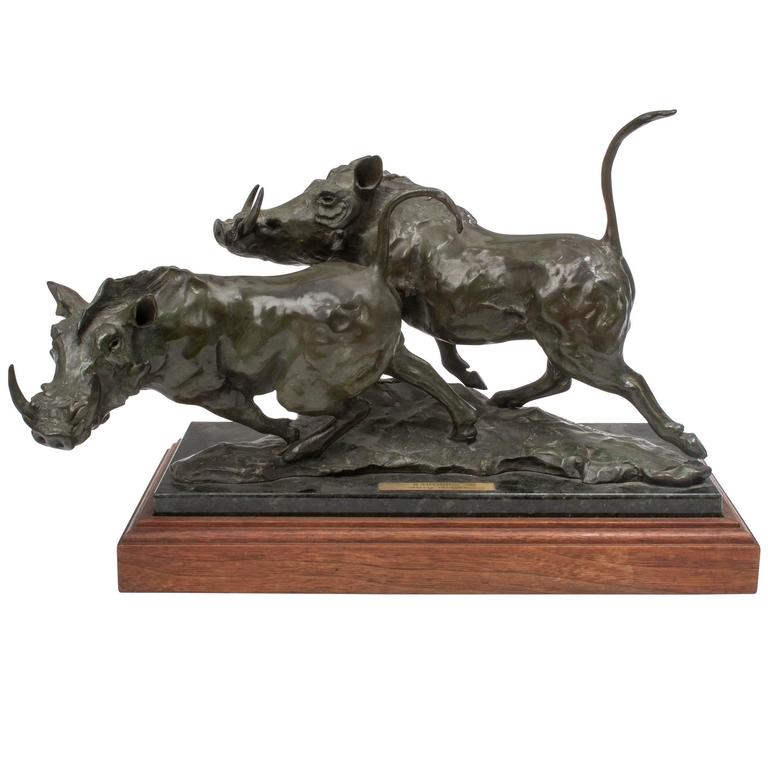
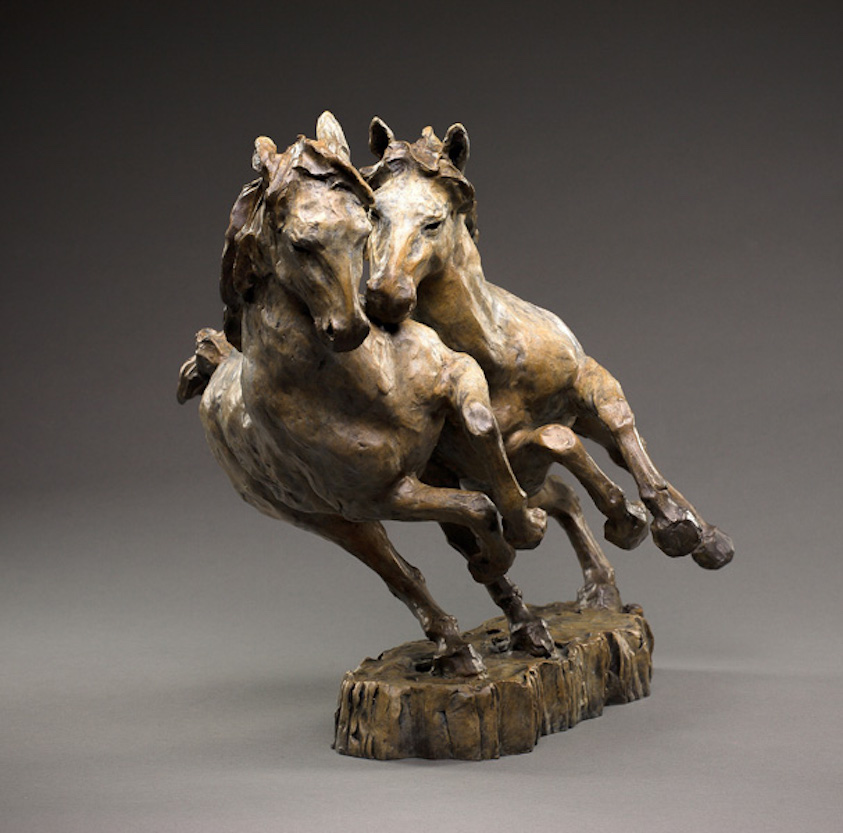
I love great animal sculptures.
Especially when there is movement involved, or when the pose reveals the animal's character.
Sherry Sander is an American sculptor who has high standards and emerges through the often uninspired scene of midwestern wildlife art. There is a raw quality to her work that reminds me of Rodin and the great Rembrandt Bugatti. Sander travelled all over the world to study animals, and it is that research that gives her sculptures a beautiful sense of authenticity.
Here is the link to her website:
http://www.sherrysanderstudio.com


----
Read in my feedly
Sent from my iPhone
Subscribe to:
Posts (Atom)